

+44 (0)20 8647 1908
Have Any Questions?
+44 (0)20 8647 1908
Have Any Questions?

List of Symbols

Dynamic Performance Investigation of Base Isolated Structures
By Ather K. Sharif
Definition of decibel scaling used

It is important that the signal of interest, in this case the response due to the train source is clearly above ambient levels

The magnitude of a level in decibels is ten times the logarithm to the base 10 of the ratio of power-like quantities, i.e.
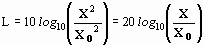

where: L level of power-like quantity

= quantity under consideration

XO = reference quantity of the same kind

A difference in the levels of two like quantities X1 and X2 is described by the same formula because, by the rules of logarithms, the reference quantity is automatically divided out as follows:

Where Transmissibility (insertion loss or gain) is defined as the non-dimensional ratio of the response amplitude of a system to the excitation amplitude. The ratio may be one of forces, displacements, velocities or accelerations. A doubling of level causes a 6dB increase, and a tenfold change is equivalent to 20dB. positive insertion loss indicates a disbenefit, and conversely a negative insertion loss indicates a benefit.

The word ‘disbenefit’ is not currently in the English dictionary, although is used to convey the obvious interpretation.

Abbreviations used in Figures

SDOF single degree of freedom

FE finite element


Trans transmissibility


crit critical damping ratio


ch channel


psd power spectral density (auto spectrum)


col column


TR test room


V vertical


L longitudinal


T tangential

List of Symbols
Chapter 2

h depth of source


VP P wave velocity


VR Rayleigh wave velocity


VS S wave velocity

Chapter 3

aw frequency weighted acceleration

t time


VDV Vibration Dose Value

Chapter 5

(t) function of time

fS spring force


fD damping force


fI inertial force


k spring constant


c damping coefficient


cc critical damping coefficient


m mass


p, po applied force


u displacement


ù du/dt (velocity)


ü d2u/dt2 (acceleration)


ur relative displacement


U absolute displacement


ug ugo ground displacement


peff effective load


Z arbitrary complex constant


s constant


w n undamped natural angular frequency


w D damped natural angular frequency


x damping ratio


Z1, Z2 constants


A constant


B constant


C vector amplitude

  • vector amplitude

q phase angle


G1 G2 constants

  • frequency ratio
  • phase angle

y 1, y 2 phase angles


M Dynamic magnification factor


W work over cycle


t time


T transmissibility


h , h o loss factor


fn natural cyclic frequency


j mode number


w j angular frequency of mode j


L length of column


m integer


E Young’s modulus

  • density


x j modal critical damping ratio


w j angular frequency of mode j


D w j frequency interval for mode j

  • alpha, Rayleigh damping constant
  • beta, Rayleigh damping constant

d m logarithmic decrement determined from waveform m cycles apart


w frequency point above resonance


w frequency point below resonance


w resonance frequency


q a angle to point (a) above resonance


q b angle to point (b) below resonance


K constant


 -1


Re real


Im imaginary

Chapter 6

Gxx auto spectra of stationary random process x(t)


Gyy auto spectra of stationary random process y(t)


Gxy cross spectra between two stationary random processes


x(t) and y(t)


Ttotal Total transmissibility


Tdirect Direct transmissibility


x(t) function of time (t)


y(t) function of time (t)


h(t ) unit impulse response function


H(f) Fourier transform of impulse response function


Y(f) finite Fourier transform of y(t)


X(f) finite Fourier transform of x(t)


g xy2(f) coherence function

  • standard deviation

mean value of a random variable


Be effective bandwidth of spectral window


T record length

  • number of statistical degrees of freedom

n number of adjacent spectral lines to the side of central value


e b bias error


Br half power point bandwidth at resonance


x critical damping ratio


fr resonance frequency


e r random error


To optimum averaging time


Bo optimum bandwidth


CT time resolution bias error coefficient

Chapter 7

Transmissibilities


D1 test block to un-loaded raft


D2 test block to raft loaded with un-isolated mass on ‘rigid’ blocks


D3 test block to un-isolated mass


D4 test block to isolated mass


D5 test block to raft loaded with isolated mass


D6 raft loaded with isolated mass to isolated mass


S= Component area


a i = Component sound absorption coefficient


W = sound power (watts)


r c = characteristics impedance of air (407 mks rayls)


Sx = area of radiating surface (m2)


V = r.m.s velocity of vibration of surface (m/s)?


SWL = Sound Power Level (dB) ?


Wref = 10-12 watts


SPL =Sound Pressure Level (dB re20m Pa)?



S = total surface area of room (m2)


Lp = SPL dB re 20Pa


La = rms vibration acceleration of floor (re: 10-6g)


f = frequency, either octave or 1/3rd octave


Lv = Vibration re 10-5m/s2


LAmaxf = A-weighted maximum SPL using fast time weighting


Lvmax = vibration velocity re 10-9 m/sec

Chapter 10
Appendix 3.1

aw frequency weighted acceleration


VDV Vibration Dose Value


eVDV estimated Vibration Dose Value


aw(rms) r.m.s frequency weighted acceleration


t event duration


n event number


N total number of events


r.m.s root mean square


r.m.q root mean quad

Appendix 8.1

F = force


mr = mass x radius of gyration


w = angular frequency

Cart (0 items)

Center for Applied Engineering Science

Contact Info

Mon - Frd : 8:00 -16:00
+44 (0) 20 8647 1908
+44 (0) 20 8405 2076
ced@environmental.co.uk

Office Address

Civil Engineering Dynamics Ltd 8-11 Oak Walk, BedZED Centre Hackbridge, Surrey SM6 7DE