
Dynamic Performance Investigation of Base Isolated Structures
By Ather K. Sharif
5.1 Theory of Isolation (SDOF model)
Base isolation is traditionally evaluated using a single-degree-of-freedom (SDOF) model (position completely described by a single co-ordinate). Mass, stiffness and damping properties are each assumed to be concentrated in a single element, as shown in Diagram 5.1(a). A theoretical description of a damped SDOF system to a harmonic force are well known (see for example Den Hartog, 1934; Meirovitch, 1986; Clough and Penzien, 1993; Harris, 1995, Newland, 1989).
An expression of the equilibrium of all the forces on the mass in Diagram 5.1(b) can be used to write an equation of motion from Newton’s 2nd law.
There is an elastic resistance to displacement, provided by a weightless spring k, which acts in a direction opposite to the displacement. There is a damping force proportional to velocity, when provided by a viscous damper, and acts in a direction opposite to the velocity of motion. A mass develops an inertial force proportional to its acceleration and opposing it (d’Alembert’s principle). We can write eqns. 5.1-3:
Because displacement u(t) is referenced from static equilibrium position, effect of gravity can be ignored in the equation of motion (spring force due to static displacement ‘cancels’ with weight of rigid body).
Diagram 5.1 described a situation where a mass is acted upon by a dynamic load p(t). Yet in a base isolation application, it is motion of the support (ug(t)) which leads to a response of the mass (U(t)) that is of interest as described in Diagram 5.2.
Equilibrium of forces for this case gives:

![]()
Noting that U(t) represents absolute displacement, and ur(t) relative displacement
Equation of motion in terms of two variables U(t) and ur(t) is:

![]()
Using eqn. 5.6, we can rewrite this as:

![]()
Since ground acceleration represents dynamic input to mass, it is convenient to write

![]()
Eqn. 5.10 is similar to eqn. 5.4. Therefore a mass acted upon by a direct load p(t) is similar to support motion, which leads to an effective load peff (t).
We could alternatively write eqn. 5.8 as:

![]()
![]()
The term kug on the R.H.S. of eqn. 5.12 explains the intuitive idea that elastic support using a softer spring can reduce the effective loading on a mass due to a given ground motion.
Returning to eqn. 5.4, it has been shown that p(t) can be used to represent a load applied directly, or an effective load resulting from support motion. If we assume in the first instance that there is no applied load, we can obtain the free vibration response, obtained as a solution of the homogeneous differential eqn. 5.13:

![]()
We can assume a solution of the form:

![]()
Substituting 5.14 into 5.13 gives after dividing by m and Zest and introducing the notation w n2 º k/m (where w n is the natural frequency) the characteristic equation:

![]()
Whilst a solution with zero damping are instructive (see Meirovitch, 1986), we proceed with a damped system for brevity, and characteristic equation has solutions:![]()

![]()
Three types of motion are described, according to whether the quantity under the square root sign is zero (critically damped), positive (over critically damped), and negative (under critically damped). The condition of critical damping arises when:
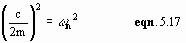
Damping coefficient c is now referred to as critical damping coefficient cc = 2mw n
A critically damped condition represents the smallest amount of damping for which no oscillation occurs in free vibration response (i.e. mass from displaced position returns asymptotically back to zero). For an over-damped system, the asymptotic return to zero is slower, according to the amount of damping. Neither of these cases are of real interest here, which leaves the under critically damped condition (c<cc).
It is convenient to express damping in terms of critical damping ratio x :![]()

Substitute eqn. 5.18 into 5.16, gives:![]()
![]()
Which from eqn. 5.14, and the two values of s in eqn. 5.19 gives![]()

The terms in the square brackets can be depicted as vectors rotating counter clockwise and clockwise with angular velocity w D and the magnitude of the vectors decay exponentially with time on account of the term outside the square brackets. For the response u(t) to be real, Z1 and Z2 are complex conjugates, and the imaginary components of the two vectors cancel each other (see Clough and Penzien, 1993).
Eqn. 5.21 can be expressed in equivalent trigonometric form using Euler’s transformation e± iq = cosq ± isinq .
Length of vectors diminish exponentially in accordance with term e–x w nt of eqn. 5.24. This rotating vector representation can be shown as a time history by projecting the rotating vector on to the real axis (or imag axis).
Returning to eqn. 5.4, we can assume a harmonically varying load p(t) of sine wave form, with amplitude po and driving frequency w . Divide by m and note that c/m=2x w n gives:

![]()
The complementary solution of the homogeneous form of this equation is the damped free vibration response given by eqn. 5.22. The particular solution is of the form:

![]()
Substituting eqn. 5.28 into 5.27 and separating into cosw t and sinw t terms gives two simultaneous equations providing expressions for G1 and G2, which can be substituted into eqn. 5.28.
The total response is given as the sum of the complementary solution and the particular solution (frequency ratio l =w /w n), using the principle of superposition.

The constant A and B of the complementary part of this solution (first term) can be evaluated for any initial conditions of displacement and velocity. However it represents the transient response, which damps out according to e–x w nt and therefore is of less interest here. The second term represents the steady state harmonic response. We can express the second term of eqn. 5.29 as:

![]()
In which
![]()
![]()
The dynamic magnification factor M, is defined as the ratio of harmonic response amplitude to static displacement produced by the force po.

![]()
The magnification factor (M) and the phase angle (f ) are shown in Figure 5.1 and Figure 5.2, for various values of damping ratio x . The frequency at which maximum displacement response occurs (resonance frequency), is not at the undamped natural frequency w n, but at a frequency slightly less than this according to eqn. 5.34. Whereas velocity response peaks at w n and acceleration response peaks at a frequency slightly above w n (see Blake , 1995). For low values of damping these differences may be ignored.

![]()
To help understand Figures 5.1 and 5.2, it is instructive to examine the motion and force vectors, which are assumed as the Real or Imaginary components of the complex form (eiw t), shown in Diagram 5.4.
The actual motion and forces arise by resolving the complex vector into real or imaginary components according to convention adopted for applied dynamic load. All the motion and forces arise in the degree of freedom direction (u). The phase relationship of the vectors are shown for one snapshot of time and frequency ratio l .
At low frequencies, the damping and inertia forces are negligible so that po » kG , with phase angle f » 0. At very low frequencies this is effectively the static case, where response is controlled by stiffness.
With increasing frequency, the damping force grows (cw G ), but the inertia force (mw 2G ) grows still faster. The phase angle must increase to cause the applied force po to balance cw G . The inertia force vector will grow until it balances the spring force, at which point the phase angle must be 90° such that po= cw G . Energy introduced into each cycle from the applied force is matched by the energy taken out of the system through damping as heat. This happens when the applied frequency equals the natural frequency (resonance) because mw n2 G = kG (i.e. w n2=k/m). Response at resonance is therefore limited by damping.
Above the natural frequency inertia force vector will grow larger than stiffness force vector, such that po must now adopt a phase angle greater than 90° . For very high frequencies, spring force kG is insignificant with respect to inertia force mw 2G , so that the applied force po balances inertia force, with phase angle approaching 180° . The applied force therefore opposes motion. Response of the object is less than would have arisen in the static case, referred to as isolation, and this response is limited by mass.
We can appreciate why it is that vibration builds up when w = w n and phase angle is 90° , by reviewing the concept of work done by a harmonically varying force upon a harmonic motion of the same frequency (Den Hartog, 1934), as follows:
Referring to Diagram 5.1(a) , we can assume a force p(t) = po sinw t to act upon a mass which has a response u(t) = G sin(w t – f ). The work done by a force during a small displacement du is pdu. This can be written as pdu.dt/dt. During one cycle of vibration w t varies from 0 to 2p , and so t varies from 0 to 2p /w . We can calculate the work done during one cycle (W) as: …
From this we can see that the component of force p(t) in phase with displacement u(t), (f =0) does no net work over a cycle. Whilst it will do work during part of a cycle, in another part of the cycle it does negative work, such that over a complete cycle zero work is done. The maximum amount of work is done over a cycle, when the force is (f = 90° ) out of phase with the displacement u(t). Hence we can see that over a number of cycles vibration will build up. We have seen that this build up reaches a limit when input energy matches energy dissipated by damping.
The forgoing related to the response of a mass subject to a direct dynamic load. In a base isolation application, it is motion of the support that leads to an effective dynamic load, as shown in eqn. 5.10, and a solution can be obtained as follows.
If we assume a harmonic support motion of the form:

![]()
Which gives an effective loading
Recall from eqn.5.33:

![]()
Substitute po max º peff max º mw 2 ugo
Using eqn. 5.30

![]()
Recall from eqn. 5.6
![]()
Which gives
![]()
Adding vectors gives:
![]()
Transmissibility is defined as amplitude ratio of mass to base motion.

![]()
This is plotted in Figure 5.3. It is instructive to examine the motion and force vectors of this situation in Diagram 5.5 (let D = ugoMsqrt(1+(2x l )2) for eqn. 5.46)
We see that positive deflection (U) leads to a force in the opposite direction on the mass, yet positive displacement ug leads to a force in the same positive direction on the mass. Vector addition of forces would give a closed polygon, for dynamic equilibrium.

![]()
Note that:
![]()
![]()
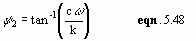
Response displacement lags behind the input displacement by phase angle y 1 given in the following equation, which is plotted in Figure 5.4, as a function of x and l .
4.2 At Source
In certain situations, vibration control implemented at the source can be the most effective and economical option. This may for industrial machinery entail isolating the source, undertaking maintenance on the plant, altering the design of plant, procuring new plant or adopting different work practice. For highway sources, the quality of the running surface is critical, and often the main disturbance is associated with vehicles traversing potholes/loose manhole covers, which may be easily remedied, although there is growing use of road humps which give rise to adverse comments (Watts, 1997). The effect of low frequency airborne noise from engine exhaust may be critical in certain situations. As railway sources are often the main reason for base isolation, some specific options for control measures at the source in the context of a railway are described in more detail.
VEHICLE
Reduction in Unsprung Mass: It has been shown by the earliest investigators (Mallock, 1902), that a reduction in unsprung mass can provide a significant reduction in wayside vibration. However, an increase in unsprung mass may be beneficial in some case as it can reduce the resonance frequency of the unsprung mass/track resilience, thereby moving the dominant frequency of the groundborne noise into a less audible region (ORE D151 Report 12, 1989).
Reduction in Primary Suspension Stiffness: Vehicles with softer vertical primary suspension produce less vibration than vehicles with stiff suspension, by reducing the coupling of mass of other vehicle elements to the unsprung mass.
Selection of appropriate Damper System: Some friction dampers can lock, increasing the effective unsprung mass.
Resilient Wheels: Used in some cases for light underground railways where axle loads are small. Can reduce groundborne noise at frequencies above 50-60Hz (Wilson et al, 1983).
Wheel Truing: Turning wheels on a lathe will remove wheel-flats and any out-of-roundness.
Slip-Slide Control systems: To minimise development of wheel-flats during skidding.
Alteration of Speed: Increase in speed does increase vibration level, although not linearly. There may be a critical lower speed that causes higher vibration levels due to local conditions.
TRACK:
Continuous Welded Rail: In place of jointed rail, to reduce impacts.
Rail Straightness: Manufacturing rails to a higher standard to reduce low frequency ground vibration associated with rails straightened by rollers in the factory. A higher standard of rail straightness is used in Europe for high speed railways.
Rail Grinding: Rail grinding machines can be used to grind the rail to a smoother profile to remove corrugation. However the grinding stones will follow the rail, and therefore will not eliminate the long wavelength features. Is mainly used for underground railways, and can be significant in reducing groundborne noise.
Resilient Rail Fasteners: Resilient pads can be introduced directly beneath the rail ‘rail pads’ or beneath the baseplate which supports the rail, see Figure 4.1b(i),(ii). They can provide a moderate degree of vibration isolation relative to standard fasteners (~5dB above 30/40Hz), and can allow better rail-head positioning control. However, at low frequencies (<30Hz) ground vibration levels can be 2/3dB higher relative to standard fasteners, and airborne sound levels can be increased (Nelson,1996). The softness selected for the resilient element is limited by factors such as increased rail stress and gauge widening.
Booted Sleepers (or Sleeper Soffit Pads): Involve a resilient pad between the sleeper and the top of the ballast (see Figure 4.1a(ii)) which can reduce track settlement, or directly onto concrete in a non-ballast track (see Figure 4.1b(iii)). Can provide attenuation in ground vibration above 30Hz. There can be an increase in airborne sound levels. Mainly used in tunnels, particularly with non-ballast track, owing to height restrictions. For at grade situations winter weather can cause problems if water accumulates in the resilient boots and freezes.
Ballast Thickness: Where ballast is used, it introduces a resilience, which is affected by its thickness. The ballast is typically 30cm thick but an increase in thickness has not been found to produce a measurable effect on wayside vibration, whilst decrease of ballast thickness below 30cm can lead to a noticeable deterioration. Ballast which has been tamped after a long period can make an improvement, emphasising a benefit of maintenance (Eisenmann et al, 1985). In contrast, ORE (D151 Report 2, 1982) shows a benefit of increasing ballast thickness on a concrete invert, but at low frequencies (6dB reduction at <10Hz due to ballast thickness from 30cm to 75cm).
Concrete Slab below Ballast: A concrete slab can be built below the ballast for at grade situations where the soil is soft. It moves the resonance frequency upwards, thereby reducing low frequency vibration, which may have been a problem. But this does increase the level at higher frequencies due to the spectral shift.
Ballast Mats: A resilient mat (typically 25mm to 60mm thick) can be placed beneath the ballast (see Figure 4.1a(iii)). The mat can either bear directly on the soil (or sub-ballast), in which case it can be less or totally ineffective when the support modulus of the soil is comparable to that of the ballast mat. An alternative is to form a concrete slab beneath the ballast mat. The mats can provide attenuation of about 10dB above 30Hz for railways at grade relative to standard ballast-and-tie track, with some magnification around the mass spring resonance frequency (<30Hz). In a tunnel the performance may be better, owing to the higher stiffness of the concrete invert for a tunnel, compared to an at grade situation. An increase of ballast thickness on a ballast mat is however beneficial (~4dB improvement going from 30cm to 60cm thickness of ballast on a ballast mat (Eisenmann et al, 1985)). A beneficial effect in wayside vibration was also seen when an increase in mass of the ballast was achieved by laying steel rails on the ballast mat, above which was laid the ballast. The steel rails were however primarily installed to improve track stability and remove a long wavelength distortion that was seen (ORE D151 Report 12,1989). The ballast mat can introduce additional bending stresses in the rail, and ballast stability needs to be considered. The ballast mat may need some protection, (e.g. layer of sand or hard covering) to protect it from the local effect of ballast stones. Load tests on the mat are usually conducted between flat steel plates, but contact between ballast particles and the mat result in a different load-displacement pattern, warranting more appropriate test condition (ORE report DT 217, 1989).
Floating Slab Track: These involve mounting a concrete slab, which may be continuous cast in situ (e.g. Figure 4.1b(iv)), or discontinuous precast modular units, placed on isolators. The fundamental vertical resonance frequency of the concrete slab, with vehicle combination tends to be in the range 8Hz to 16Hz. Some systems are as low as 5Hz. With continuous floating slab tracks, confined air in narrow gaps may need to be considered in the natural frequency calculations. The resilient element may be synthetic/natural rubber or steel coil springs. The slabs usually achieve a mass of 4 to 10 tonnes/m. This is usually selected to at least match the train’s mass and three times the unsprung mass, where mass is considered to be distributed along the train length (Wilson et al, 1983). In order to achieve sufficient mass for the floating slabs in as small a volume as possible, to minimise the impact on tunnel size, and therefore construction costs, high-density concrete can be used (compare a density of 2400kg/m3 for normal weight concrete and heavy aggregate concrete: Barytes, 3500; Magnetite, 4000 and Iron Shot, 5900 kg/m3 ). There will be longitudinal forces induced by braking or run-up, and transverse forces on curved sections. Resilient shear keys can be provided where necessary to accommodate these forces. The support stiffness for the floating slab track can be increased at junctions to standard track forms, to provide a smooth transition. These systems, which are mainly used for underground railways, can offer a high degree of groundborne noise and vibration control (as much as 30-40dB for high frequencies, (VCE, 1997)). However the design should consider all the resonance frequencies of the floating slab. These floating track slab systems can increase the noise within a tunnel and the train. Constrained layer damping has been used in the past to minimise the sounding board effect of the floating slab, and to damp resonance modes of the deck (Grootenhuis, 1967,1968).
Slab Track: ‘Modurail’ is an example developed by an isolator supplier in Germany known as Getzner. In this case it consists of traditional concrete sleepers which have sleeper soffit pads bearing on a concrete slab. In the area between the concrete sleepers, outboard of the rails, the sleepers are resiliently connected to each other via additional precast concrete units. The system provides some benefit below 30Hz, attributed to the concrete slab, hence the name Slab Track.
There is a benefit between 60 to 200Hz due to passive isolation. An increase arises between 40 to 50Hz due to resonance frequency of the booted sleeper, and increase above 200Hz due to resonances of the entire modular track system. In general, such systems offer benefits at low frequencies due to the higher stiffness of the sub-structure, and the greater control in the precision of rail fixings. Benefits can also be seen at higher frequencies, when resilient elements are used.
Continuous Rail Support and Sleeper Pitch: Discrete rail supports cause low frequency excitation, which is a function of support passage frequency. Various means have been used to achieve continuous rail support. Edilon provide an embedded rail system where the rail is placed in a groove in the concrete, which is then filled with a cork/polymer material. These methods can show benefits in reducing ground vibration and airborne noise (Müller-BBM, 1997b).
Ground Treatments: The soil beneath the track can be stiffened by a variety of measures. Cement based grouts can be injected into granular soils. For clay/organic soils, cement and lime can be mixed in, or mixed in a way to form lime columns. Vibration reduction can be achieved at low frequencies, particularly when the existing soil is very soft to start with. But there can be an increase in levels at higher frequencies, as the resonance is moved upward (Müller-BBM,1997b; SGI, 1995).
TUNNEL:
Tunnel Alignment: Increasing the distance between the tunnel (or an at grade alignment) and a sensitive receiver, will reduce the level of vibration and groundborne noise. A small increase when the intervening distance is small can be significant, although this is less so at further distances from the source.
Tunnel Depth: A deep tunnel produces less ground vibration than a shallow tunnel. The proximity of a deeper tunnel to deep foundations of a building does however need to be considered.
Tunnel Wall Thickness: The choice of tunnel construction, e.g. increasing wall thickness, can reduce groundborne noise (Koch, 1979; Kurzweil and Ungar,1982; Lang, 1984).
4.3 In Propagation Path
The options for attenuation in the propagation path relate to increasing the distance between the alignment and the sensitive buildings at the planning stage. Alternative options may include trenches, or impedance walls. In practice the depth and length of trenches need to be comparable to the wavelength of the disturbing ground vibration, which can be long, making trenches largely impractical. The screening effect also varies as a function of distance from the trench, reducing as distance increases. Levels on the upstream side of trench may be higher due to local reflections. Impedance walls involve a concrete wall being built into the ground in the path between the source and the receiver. They will only be effective for certain soil types, where a sufficient impedance mismatch with concrete for the wall can be achieved. Impedance walls, like trenches are therefore required to be very deep and long, and may prove uneconomical or ineffective. A variation to the impedance wall (typically vertical), entails the use of ground treatments to stiffen the top layer of soil (e.g. by injecting concrete slurry) to create a wave impedance block, as a means of reducing low frequency ground vibration (see Peplow et al, 1997). Absorber blocks have also been tried in the path (see Chapter 2), but without much success. Ng (1995) has presented a method for evaluating the required length of a barrier in the propagation path using a ‘spreading-angle map’ of train induced ground vibration.
4.4 At Receiver
There are many options available at the receiver, especially for a new building.
Planning: Locate sensitive areas further from the source (e.g. relocate car parks/landscape areas closer to the source). It may also be appropriate to reconsider the proposed use of a site. For example a commercial office development would be less sensitive than a residential development, and may overall provide a more economically viable development proposal for the site.
De-Tune Floors: Alter natural frequency to avoid resonance with dominant spectrum from the source. As the human body is sensitive (direction dependent) to certain frequencies, the floor characteristics could be chosen, such that where magnification is unavoidable, it be allowed to occur in a region in which the human body is less sensitive (see Figure 3.5(a) Chapter 3). This generally requires a high floor natural frequency. But it should be recognised that this can be associated with a larger bandwidth (see Chapter 5). This means that a floor with a high natural frequency may be more likely to be excited, if the ground vibration spectrum has a peak within the bandwidth of the floor’s natural frequency. However a low natural frequency floor, although more likely to be of a frequency that is sensitive to the human body, will have a smaller bandwidth, and therefore will only be excited in resonance by frequencies closely tuned to it. There will however remain the possibility of resonances with higher modes of the floor. Low natural frequency floors are becoming common in long span situations, although there is a risk of footfall induced vibration (see ISO 10137:1992). Long span floors typically have low natural frequencies in the region of 4Hz to 7Hz. In some cases a ground floor may be suspended for construction reasons, but solid ground bearing slabs would not result in lightly damped resonance modes. In this way, bungalows with solid floors may be more appropriate at locations close to the source.
Structure Damping: Some structure types offer better damping than others, compare in-situ concrete or load bearing brick in soft mortar to steel construction. Constrained layer damping in floors or structural members may be used where a layer of non-linear material (e.g. products based on bitumen), are interposed in the floor construction. The system operates by inducing shear into the constrained layer material. This shear can only arise when there is motion of the floor. To mobilise this shear damping adequately often requires a high level of motion in the floor, which may be at an unacceptable level, leading to adverse comment. This is therefore only appropriate in certain situations, where perception is not the primary issue (see Grootenhuis, 1970; Nakra and Grootenhuis 1974; Coveney et al 1989).
Structural Design: Options include:- selection of heavier materials as opposed to lightweight; Long span support of building or long span floors to achieve low frequency for passive isolation; Increased path length by hanging floors from the tops of columns; Discontinuities by introducing construction joints; Irregular construction patterns (Hodges and Woodhouse, 1983).
Decoupling Foundations: The foundations of the building can be taken down into a deeper strata which may be less affected by ground vibration, although the foundations near the surface will need to be decoupled from the soil. This could for example be achieved by mounting the building on deep piles, with the upper shaft of the pile decoupled from the soil, by a sleeve system. This will however reduce the horizontal stiffness of the foundation system, which may require consideration. An alternative may be to site sensitive equipment directly on the ground as opposed to on suspended floors, or place the equipment on a foundation bearing deep in the soil, and decoupled from the building or soil near the surface.
Isolating Sensitive Equipment or Process Areas: Local isolation of sensitive equipment, or box-within-a-box type construction for small areas.
Floating Floors: A separate floor that is resiliently mounted off a redundant floor. Local resonances of the suspended floor and its low mass and damping are likely to compromise performance, as may the resilience of the supporting structure.
Induced Background Noise: To make the groundborne noise less intrusive by raising the background noise level. This option should be considered along with the effect that a higher level of background noise could have on factors such as telephone intelligibility or direct speech communication.
Dynamic Vibration Absorbers: These may be used in very specific circumstances where the source produces a disturbance at a specific frequency. If the structure cannot be de-tuned, it may be appropriate to design a dynamic vibration absorber, although this is unlikely to be appropriate for a railway source, as the disturbance does not arise at a fixed frequency.
Active vibration control: Can be used where opposing motion is generated using electromechanical or hydraulic actuators. It is unlikely to be a viable option in all but special circumstances (see Fuller et al, 1996), and the Author is unaware of its use in buildings to deal with vibration (or noise) from railway sources.
Base Isolation: Where the entire building, or part of it, is mounted on resilient elements (typically rubber bearings, or steel coil springs) placed at or below foundation level, or even higher up in the structure. The building is detailed in a way to avoid any rigid contact with the ground or neighbouring un-isolated structures. The dynamic performance of base isolated structures is not well known, although there are high expectations in Industry (see Chapters 1,5, and Appendix 4.1). Dynamic performance of such structures is the subject of this thesis.
4.5 Discussion
This Chapter has briefly described alternative vibration control measures directed at the Source, in the Propagation Path and at the Receiver, with particular regard to railway sources, as this is the most common reason to adopt base isolation. The most cost effective means of vibration control are likely to be measures implemented at the source. Some measures can be adopted in existing railways, with particular regard to wheel truing and rail grinding. Retrofit of either resilient rail fasteners or sleeper soffit pads are likely to be practical options.
Resilience in train and track form are introduced to provide passenger comfort and reduce wear and tear, but can also provide benefits in reducing groundborne noise and vibration. However the concept cannot be taken too far. Rail-head deflections for operational safety reasons need to be limited, typically 1.5 to 3mm. Alternative measures to introduce resilience in the track form shown in Figure 4.1, cannot be simply added together, as in some cases they may not work (Greer and Gellatley, 1998).
In new alignments, there are clearly opportunities in the planning stage to locate the track in a way that minimises its impact. Consideration of alternative alignments using a basic prediction model may help to identify the most favourable route in the context of minimum environmental impacts, although many other technical and economic factors will come into play.
There is a good deal of scope to implement vibration control measures in the vehicle and track design. Floating Slab Tracks offer a high degree of control, although at a significant cost compared to other options that may be adequate. Given the significant cost implications on a long length of track, extra effort at the design stage may provide a worthwhile economy.
Figure 4.2 shows a comparative view of the insertion loss for some options of control at the source. It relates to the options primarily used for at grade railways and therefore does not include floating slab tracks. There is clearly a broad range to the possible performance that can be achieved, where improvements in one spectral region may be accompanied by disbenefits in another.
Clearly a developer of a site will not have any authority to instigate vibration control measures at the source. Some residents have however formed local action groups and brought enough pressure to bear on Railway Operators, resulting in an investigation of the complaints and in some cases improved maintenance resulting in benefits.
Where existing buildings are subject to an adverse effect from an existing railway, little can be done within the building to reduce the impact. For new buildings on a site exposed to an existing or proposed railway, there are many opportunities for vibration and groundborne noise control, of which Base Isolation should be regarded as one option.
Conclusions
This chapter has highlighted a wide range of control measures available at the source, the limited options in the propagation path, and broad range available at the receiver. Some of the options may be considered to be viable alternatives to Base Isolation or could be considered as supplementary measures to a proposal for Base Isolation.